

Introduction
Lifting jacks are essential tools in construction, infrastructure, marine, and industrial maintenance — but they carry serious risk when used incorrectly. This guide covers the most important safety practices for heavy-duty jacks, including pre-use inspection, correct positioning, load capacity rules, and what to do when something goes wrong. Whether you’re using a hydraulic jack for bridge maintenance or industrial machinery relocation, getting the safety basics right protects both people and equipment.
Why Lifting Jack Safety is Important to Consider
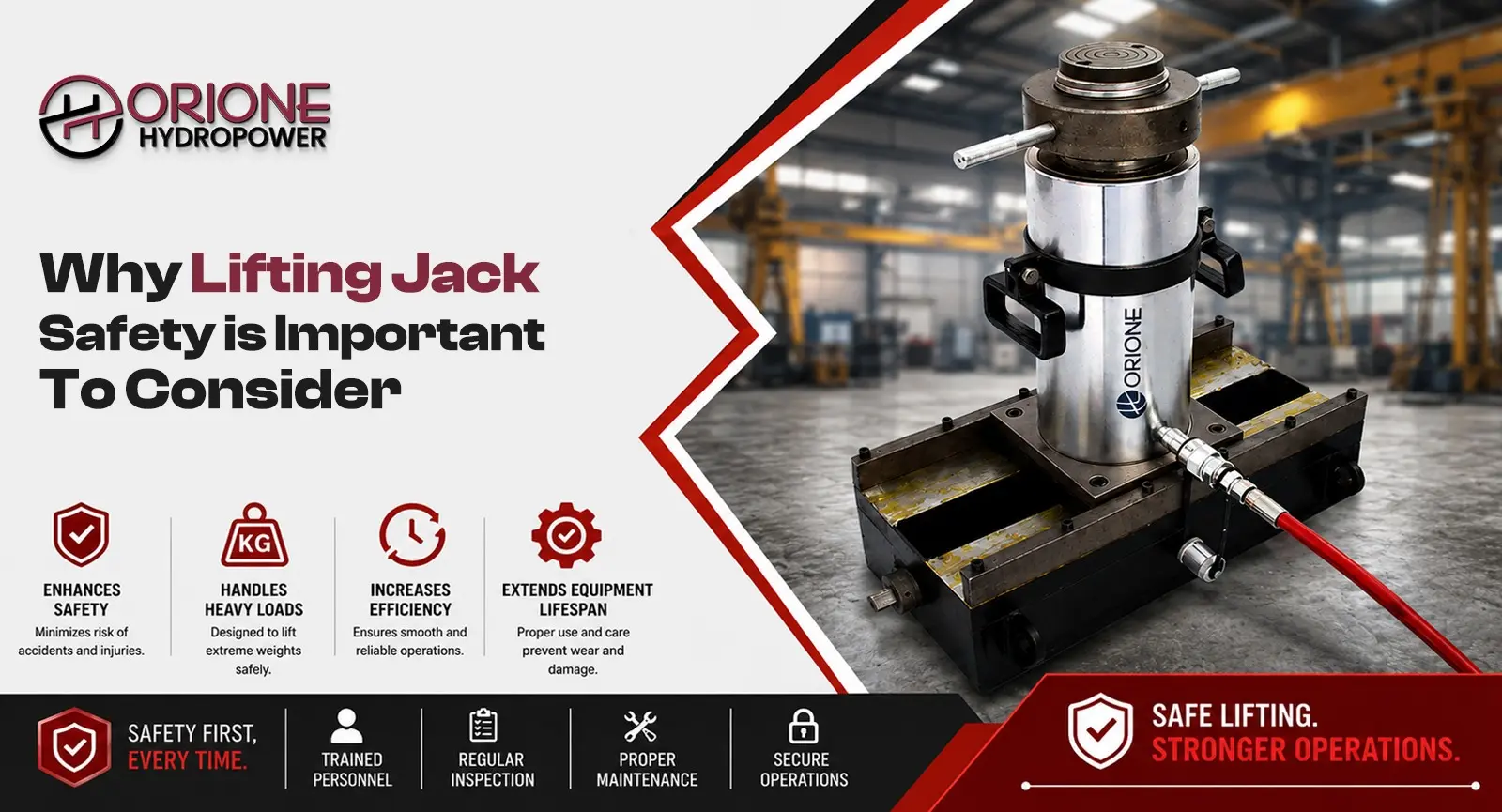
Lifting jacks are tools that people use routinely — which is exactly why safety protocols get taken for granted. The familiarity of the equipment creates a false sense of security. An operator who has used a hydraulic jack a hundred times without incident starts skipping the inspection steps, estimating loads rather than confirming them, and positioning the jack by habit rather than by checking.
Most accidents don’t happen because the lifting equipment failed without warning. They happen because someone ignored a warning — a worn seal that had been leaking for weeks, a load that was obviously close to the rated limit, or a base that wasn’t properly levelled before the lift began. This guide covers the practices that prevent those incidents before they happen.
Pre-Use Inspection — What to Check Before Every Lift
No lifting jack should be used without a visual inspection before the lift begins. This takes five minutes and is non-negotiable.
Check the following before every use:
- Hydraulic fluid level — low fluid causes erratic operation and may result in the jack failing to hold the load at height
- Seals and connections — look for oil leaks around the ram, cylinder body, and all hose connections; any active leak means the jack should not be used
- Ram condition — the ram surface should be clean and free of deep scoring, rust, or physical damage that could damage seals during operation
- Structural integrity — check the jack body for cracks, distortion, or visible damage; a mechanically compromised jack should be withdrawn from service immediately
- Threaded lock nut — on jacks with a safety lock nut, confirm the nut operates freely and engages correctly
- Hose and coupling condition — damaged hoses or loose couplings fail under pressure; replace before use
- Load rating tag — confirm the jack’s rated capacity is clearly marked and legible
If any of these checks reveals a problem, the jack does not go into service — regardless of schedule pressure.
Load Capacity — The Rule That Cannot Be Compromised
Every lifting jack has a Working Load Limit stamped on the body or indicated on the identification plate. This figure represents the maximum load the jack is designed to lift safely.
The rules around load capacity:
- Never exceed the WLL — ever; this is the single most important rule in industrial jack safety
- Calculate the actual load — never estimate; use engineering data, weight certificates, or scales to confirm the weight of the load before selecting the jack
- Apply a safety margin — select a jack with a capacity above the calculated load; working a jack at exactly its rated limit leaves no margin for dynamic loads, load shifts, or equipment degradation
- Account for eccentric loading — a load that is not perfectly centred over the jack creates bending forces that reduce the effective safe capacity; always aim for centred, vertical loading
A jack failure under an overloaded condition is sudden and catastrophic. There is no warning before the ram buckles or the cylinder gives way.
Lifting Jack Correct Positioning and Setup
How the heavy-duty jack is positioned determines whether the lift is stable or dangerous from the moment it begins.
Positioning checklist:
- Level ground — place the jack on a firm, level surface; soft ground, uneven surfaces, and slopes all affect stability and can cause the jack to tip during lifting
- Timber packing — use hardwood packing plates under the jack base on soft or uneven surfaces to distribute the load and increase stability
- Correct lifting point — place the jack saddle under the designated lifting point on the load; lifting off-centre or from a structurally unsuitable point on the load creates lateral forces the jack isn’t designed to handle
- Saddle alignment — the load should sit squarely on the saddle; a tilted load transfers lateral force to the ram, which damages seals and reduces safe capacity
Clearance — confirm adequate clearance above the jack for the full stroke required; a jack that reaches the end of its stroke before the lift is complete creates a dangerous situation
Safe Operating Practices During the Lift
Once the jack is positioned and the pre-use checks are complete, the operating phase has its own set of critical practices:
- Raise slowly and steadily — rapid pressure application causes shock loading; raise the load gradually and pause at intervals to check stability
- Engage the lock nut — on jacks with a threaded lock nut, engage it at every stage of the lift; if hydraulic pressure is lost for any reason, the lock nut holds the load in position
- Never work under an unsupported load — always use properly rated mechanical supports — stands, cribs, or props — before any person goes under a lifted load; a lifting jack alone is not a safe support for sustained load holding
- Monitor for settling — watch the load and the jack for any signs of movement, tilting, or sinking during the lift
Keep bystanders clear — establish a clear exclusion zone around the lift; no one who is not directly involved in the operation should be within the fall zone of the load
Post-Lift Procedures and Storage
- What happens after the lift is as important as what happens during it.
- Lower the load slowly — rapid descent creates shock loads on the jack and the receiving surface
- Clean the jack — wipe down the ram and external surfaces; dirt and debris accelerate seal wear
- Retract the ram fully — store jacks with the ram fully retracted to protect the ram surface and seals
- Store correctly — vertical storage in a clean, dry location prevents seal damage from extended single-side compression and protects against contamination
Document any issues — if the jack showed any unusual behaviour during the lift, log it and have the jack inspected before next use
Common Mistakes That Cause Accidents
Most lifting jack incidents trace back to one of these:
- Using a jack with a known leak or mechanical issue
- Estimating load weight rather than confirming it
- Lifting on soft or uneven ground without adequate packing
- Failing to engage the lock nut and relying on hydraulic pressure alone
- Working under a load supported only by the jack without mechanical backing supports
- Using a jack beyond its rated capacity because “it’s only slightly over”
None of these are unavoidable. All of them are the result of decisions made by the operator before or during the lift.
Final Word
Lifting jacks are dependable, heavy-duty tools when they’re matched to the right load, used on stable ground, and never trusted as the sole support for anything being worked on underneath. Most accidents involving this equipment come down to a handful of avoidable mistakes rather than actual equipment failure, which means the safety record of any job site really comes down to how consistently these basics are followed.
For businesses looking for reliable heavy-duty lifting equipment, Orione Hydropower supplies jacks built for demanding industrial and commercial applications, with the capacity and reliability serious lifting work requires.